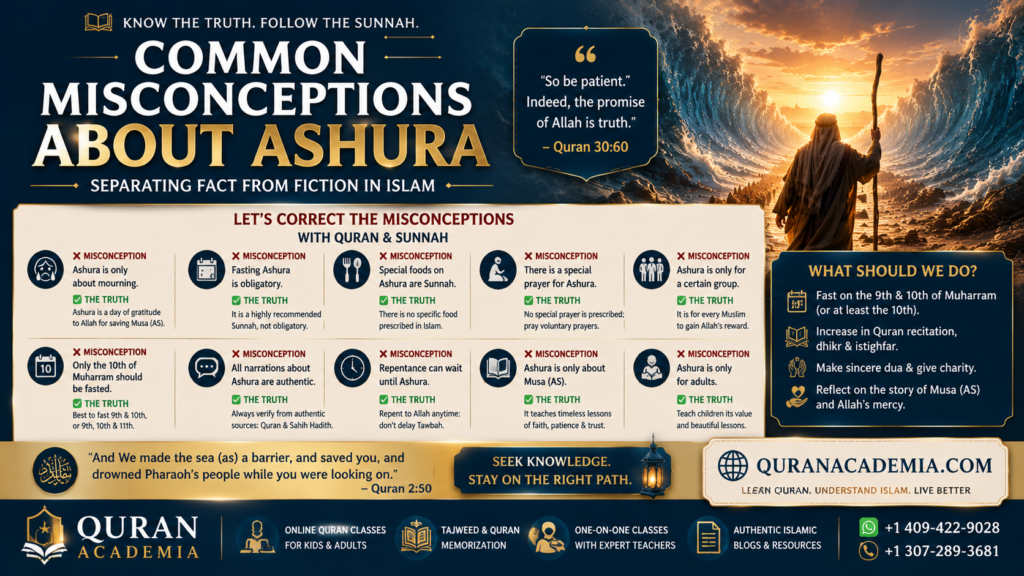
Common Misconceptions About Ashura: Separating Authentic Islamic Teachings from Cultural Practices
Common Misconceptions About Ashura
The Day of Ashura, observed on the 10th of Muharram, is one of the most significant days in the Islamic calendar. It is a day of gratitude, remembrance, and worship that commemorates Allah’s miraculous rescue of Prophet Musa (AS) and the Children of Israel from Pharaoh.
However, over the centuries, various cultural customs and unsupported beliefs have become associated with Ashura. To practice Islam correctly, Muslims should distinguish between what is authentically established in the Quran and Sunnah and what has no reliable evidence.
This guide from QuranAcademia.com explains the most common misconceptions about Ashura while highlighting the authentic teachings of Islam.
Misconception #1: Ashura Is Only About Mourning
Many people believe Ashura is exclusively a day of mourning.
The Reality
For Muslims, Ashura is primarily a day of worship, gratitude, and fasting.
The Prophet Muhammad ﷺ fasted on Ashura because Allah saved Prophet Musa (AS).
Ibn Abbas (RA) narrated:
“The Prophet ﷺ said: ‘We have more right to Musa than they do,’ so he fasted on Ashura and commanded the Muslims to fast.”
(Sahih al-Bukhari)
While Muslims remember important events in Islamic history with respect and reflection, the authentic Sunnah emphasizes fasting and gratitude on Ashura.
Misconception #2: Fasting on Ashura Is Obligatory
Some Muslims believe everyone must fast on Ashura.
The Reality
Fasting Ashura is a highly recommended Sunnah, not an obligation.
The Prophet ﷺ encouraged Muslims to fast because of its tremendous reward, but after Ramadan became obligatory, fasting Ashura remained voluntary.
Aisha (RA) said:
“Whoever wished could fast it, and whoever wished could leave it.”
(Sahih al-Bukhari & Sahih Muslim)
Misconception #3: Only the 10th of Muharram Can Be Fasted
Many believe fasting only on the 10th is the complete Sunnah.
The Reality
The Prophet ﷺ expressed his intention to also fast the 9th of Muharram.
He said:
“If I live until next year, I will certainly fast the ninth.”
(Sahih Muslim)
The preferred practice is:
- Fast the 9th and 10th
- Or the 9th, 10th, and 11th
- At minimum, fast the 10th
Misconception #4: There Are Special Prayers Prescribed for Ashura
Some people believe Islam prescribes a unique salah specifically for Ashura.
The Reality
There is no authentic hadith establishing a special prayer exclusively for Ashura.
Instead, Muslims are encouraged to increase:
- Voluntary prayers
- Quran recitation
- Dhikr
- Dua
- Charity
- Seeking forgiveness
Misconception #5: Certain Foods Must Be Cooked on Ashura
In some cultures, families prepare specific dishes believing they carry special religious rewards.
The Reality
Islam does not prescribe any particular meal or food for Ashura.
Preparing food for family is permissible as a cultural practice, but believing it has a specific religious virtue without authentic evidence is incorrect.
Misconception #6: Every Narration About Ashura Is Authentic
Many statements about Ashura circulate on social media without verification.
The Reality
Muslims should verify religious information before sharing it.
Allah says:
“O you who believe! If a sinner comes to you with news, verify it…”
(Quran 49:6)
Always rely on authentic sources such as the Quran and sound Hadith.
Misconception #7: Worship Is Limited to Fasting
Some people think fasting alone is enough.
The Reality
Ashura is an excellent opportunity to increase all forms of worship:
- Reading the Quran
- Making sincere dua
- Giving charity
- Helping others
- Remembering Allah
- Repenting from sins
The more righteous deeds performed sincerely, the greater the reward.
Misconception #8: Ashura Is Only Relevant to the Story of Musa (AS)
While the salvation of Prophet Musa (AS) is the primary reason for fasting Ashura, some assume the day has no broader lessons.
The Reality
Ashura teaches universal values:
- Trust in Allah (Tawakkul)
- Patience (Sabr)
- Gratitude (Shukr)
- Courage
- Hope
- Reliance on Allah during hardship
These lessons remain relevant for every Muslim today.
Misconception #9: Delaying Repentance Until Ashura Is Acceptable
Some people wait until Ashura to seek forgiveness.
The Reality
Allah accepts sincere repentance throughout the year.
Ashura is a wonderful opportunity to repent, but believers should never delay returning to Allah because no one knows when life will end.
Misconception #10: Ashura Is Only for Adults
Some parents overlook involving children in the day.
The Reality
Ashura is a valuable opportunity to teach children:
- The story of Prophet Musa (AS)
- The importance of fasting (as appropriate for their age and ability)
- Gratitude to Allah
- The significance of Muharram
- Love for the Prophets
Helping children appreciate these lessons strengthens their Islamic identity.
What Should Muslims Do on Ashura?
The authentic Sunnah encourages Muslims to:
- Fast on the 9th and 10th of Muharram (or at least the 10th).
- Read and reflect upon the Quran.
- Increase in dhikr and istighfar.
- Make heartfelt dua.
- Give charity.
- Perform voluntary prayers.
- Reflect on the story of Prophet Musa (AS) and Allah’s promise of victory for the believers.
Learn Authentic Islam with QuranAcademia.com
Understanding Islam through authentic sources protects us from misconceptions and innovations.
At QuranAcademia.com, you’ll find:
- 📖 Online Quran Classes for Kids & Adults
- 🎓 One-on-One Quran Learning with Qualified Teachers
- 🌍 Tajweed & Quran Memorization Courses
- 📚 Authentic Islamic Blogs on Muharram, Ashura, Ramadan, Hajj, and the Stories of the Prophets
- 🤲 Daily Islamic Reminders and Practical Worship Guides
Whether you’re beginning your Quran journey or seeking to deepen your Islamic knowledge, QuranAcademia.com offers trusted, Quran- and Sunnah-based learning for Muslims worldwide.
Conclusion
Ashura is a day rooted in authentic worship, gratitude, and remembrance of Allah’s mercy. By avoiding misconceptions and following the guidance of the Quran and Sunnah, Muslims can observe Ashura in the manner taught by the Prophet Muhammad ﷺ.
May Allah grant us authentic knowledge, accept our worship, and make us among those who follow the Sunnah with sincerity. Ameen.