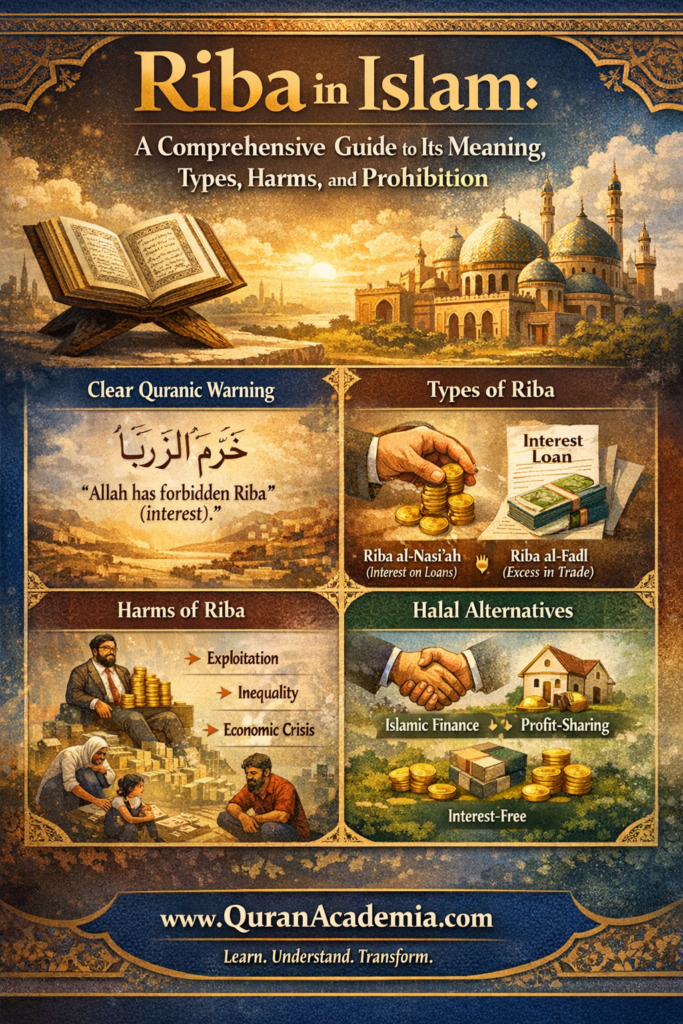
Riba in Islam: A Comprehensive Guide to Its Meaning, Types, Harms, and Divine Prohibition
Introduction: Why Understanding Riba Is Essential for Every Muslim
Riba (interest or usury) is among the most severely condemned sins in Islam, mentioned repeatedly in the Qur’an and Sunnah with warnings unparalleled in intensity. In a world dominated by interest-based financial systems, understanding Riba is no longer optional—it is an obligation of faith, ethics, and survival of Islamic economic justice.
Allah ﷻ does not merely discourage Riba; He declares war against those who persist in it. This alone makes Riba one of the most critical topics in Islamic jurisprudence, spirituality, and socio-economic reform.
This in-depth guide explores:
-
The linguistic and technical meaning of Riba
-
Types of Riba according to Qur’an and Sunnah
-
Clear Qur’anic prohibitions
-
Authentic Hadith references
-
Scholarly consensus (Ijma‘)
-
Economic, spiritual, and social harms
-
Riba in modern banking
-
Halal alternatives
-
Practical steps to avoid Riba
This article is written to serve as a definitive educational resource for students, teachers, and general readers of QuranAcademia.com.
What Is Riba? (Definition and Linguistic Meaning)
Linguistic Meaning
The Arabic word Riba (رِبَا) literally means:
-
Increase
-
Excess
-
Growth beyond what is justified
Shari‘ah Definition
In Islamic law, Riba refers to:
Any guaranteed excess or benefit taken without legitimate trade or risk.
Imam Ibn Qudamah defines Riba as:
“An increase without a lawful counter-value.”
In simple terms:
👉 Any predetermined increase on a loan = Riba
Riba Before Islam: A Tool of Exploitation
Before Islam, Riba was widely practiced in:
-
Pre-Islamic Arabia
-
Roman Empire
-
Greek civilizations
-
Ancient Jewish money-lending systems
A common practice:
“Delay your payment, and I will increase your debt.”
This led to:
-
Endless cycles of poverty
-
Enslavement
-
Family destruction
Islam came not merely to regulate Riba—but to abolish it entirely.
Clear Prohibition of Riba in the Qur’an

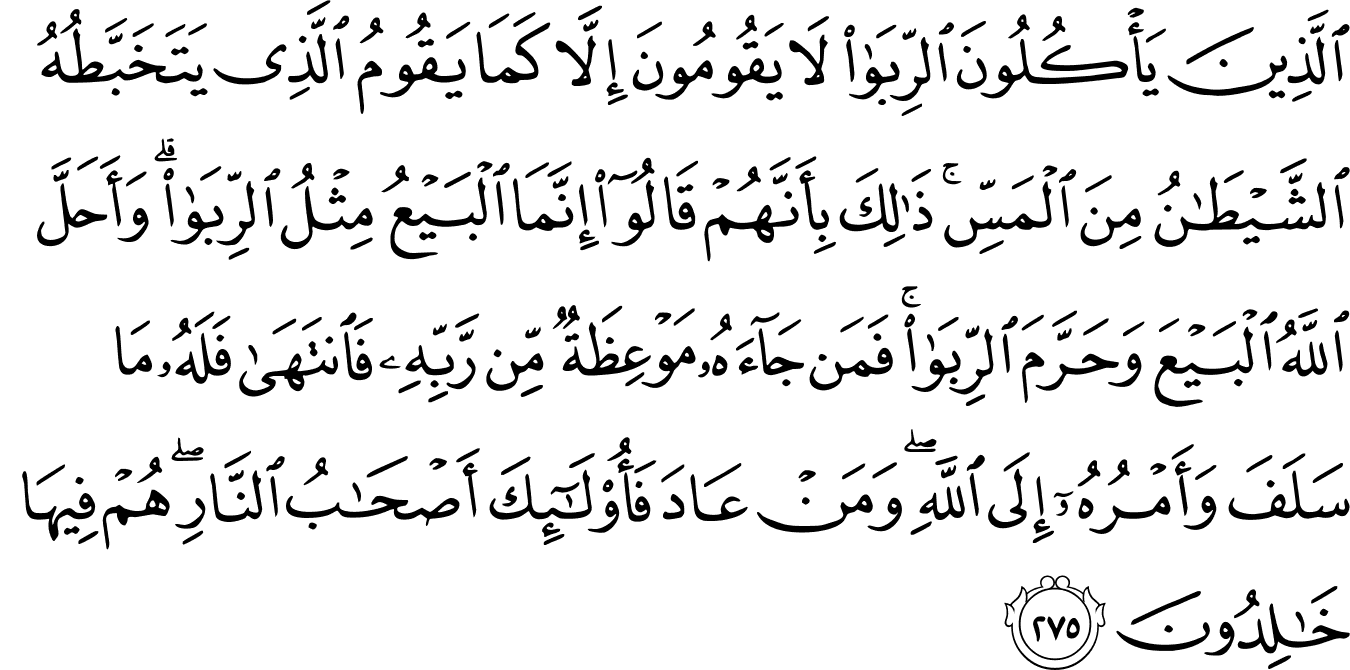
The Qur’an mentions Riba explicitly in four major revelations, each stronger than the last.
1. Surah Al-Baqarah (2:275)
📖 Qur’an
“Those who consume Riba will not stand on the Day of Resurrection except as one stands who is being beaten by Satan into insanity…”
This verse:
-
Describes psychological and spiritual corruption
-
Refutes the false claim: “Trade is like Riba”
2. Surah Al-Baqarah (2:278–279)
“O you who believe! Fear Allah and give up what remains of Riba, if you are truly believers. And if you do not, then be informed of a war from Allah and His Messenger.”
⚠️ No other sin carries a declaration of war from Allah.
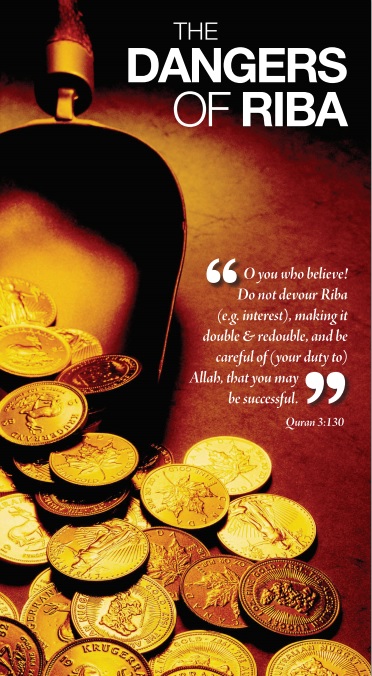
3. Surah Aal-Imran (3:130)
“O you who believe! Do not consume Riba, doubled and multiplied, and fear Allah so that you may be successful.”
4. Surah An-Nisa (4:161)
“…and for their taking of Riba while they had been forbidden from it…”
This verse connects Riba to divine punishment upon previous nations.
Riba in the Sunnah of the Prophet ﷺ
The Prophet Muhammad ﷺ intensified the Qur’anic warning.
Major Hadith on Riba
📘 Sahih Muslim
“The Messenger of Allah cursed the one who consumes Riba, the one who gives it, the one who records it, and the two witnesses—and he said: They are all the same.”
📘 Sahih al-Bukhari
“A dirham of Riba consumed knowingly is worse than committing zina thirty-six times.”
📘 Sunan Ibn Majah
“There will come a time when people will consume Riba, and if they do not consume it directly, its dust will reach them.”
Types of Riba in Islamic Jurisprudence
Islamic scholars unanimously agree that Riba has two primary forms.
1. Riba al-Nasi’ah (Interest on Loans)
This is the most common and dangerous form.
Definition:
Any increase demanded due to time delay in repayment.
📌 Examples:
-
Bank interest on loans
-
Credit card interest
-
Mortgage interest
-
Late payment penalties
Scholarly Consensus:
👉 All forms of interest-based loans are Haram.
2. Riba al-Fadl (Excess in Trade)
📘 Based on Hadith in Sahih Muslim
The Prophet ﷺ said:
“Gold for gold, silver for silver… equal for equal, hand to hand.”
This applies to six commodities:
-
Gold
-
Silver
-
Wheat
-
Barley
-
Dates
-
Salt
Any unequal exchange without immediate possession is Riba.
1. Riba Destroys Social Justice
-
Rich become richer
-
Poor remain trapped
-
Wealth circulates among elites
📖 Qur’an (59:7):
“So that wealth does not circulate only among the rich among you.”
2. Riba Kills Compassion
Loans become tools of profit—not mercy.
Islam encourages:
-
Qard Hasan (benevolent loans)
-
Charity
-
Risk-sharing
3. Riba Creates Economic Crises
Modern financial collapses (2008 crisis) were rooted in:
-
Interest-based debt
-
Speculation
-
Greed
Islam promotes real economic productivity, not artificial debt growth.
4. Riba Destroys Spirituality
The Prophet ﷺ warned:
“When Riba and zina become widespread, people invite Allah’s punishment.”
Riba hardens the heart and blocks du‘a acceptance.
Riba vs Trade: The False Comparison
Allah directly refutes the claim:
“They say: Trade is like Riba. But Allah has permitted trade and forbidden Riba.” (2:275)
| Trade | Riba |
|---|---|
| Risk involved | No risk |
| Mutual benefit | One-sided |
| Real economy | Artificial debt |
| Halal | Haram |
Common Modern Forms of Riba
-
Savings account interest
-
Fixed deposits
-
Conventional mortgages
-
Student loans
-
Car financing
-
Bonds
Even small percentages do not make Riba halal.
Islamic Finance: Halal Alternatives to Riba
Islam does not prohibit profit—it prohibits injustice.
Halal Financial Models
-
Murabaha (cost-plus sale)
-
Mudarabah (profit sharing)
-
Musharakah (partnership)
-
Ijara (leasing)
-
Qard Hasan (interest-free loan)
These models:
✔ Share risk
✔ Encourage transparency
✔ Promote fairness
Repentance From Riba: Is It Possible?
Yes. Allah’s mercy is greater than all sins.
📖 Qur’an (2:278):
“If you repent, you may have your principal—neither oppress nor be oppressed.”
Steps of Repentance
-
Stop engaging in Riba immediately
-
Regret sincerely
-
Return excess wealth if possible
-
Seek Allah’s forgiveness
-
Commit to halal alternatives
Frequently Asked Questions About Riba
Is bank interest always haram?
Yes. Consensus (Ijma‘) exists among scholars.
What if there is no Islamic bank available?
Necessity is limited to life-threatening situations, not convenience.
Is inflation-adjusted interest halal?
No. Any guaranteed excess remains Riba.
Conclusion: Riba Is a War No Believer Can Afford
Riba is not merely a financial sin—it is:
-
A spiritual disease
-
A social injustice
-
A cause of divine anger
Islam offers a complete alternative—rooted in justice, mercy, and balance.
Avoiding Riba is not just about money.
It is about faith, obedience, and trust in Allah.