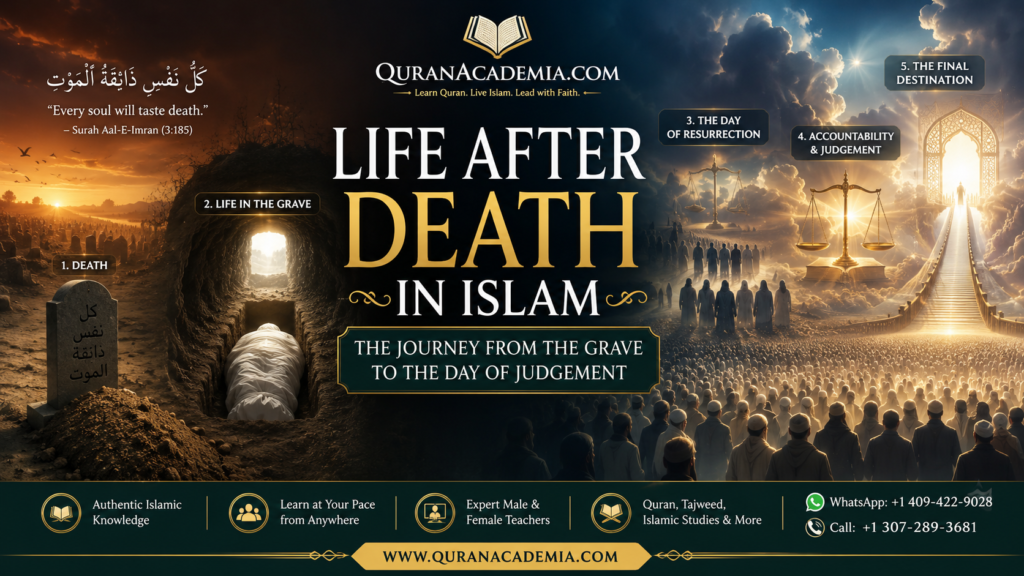
Life After Death in Islam: The Journey from the Grave to the Day of Judgement
For every soul that has ever lived, death is not an ending — it is a doorway. Life after death in islam unfolds in clear, divinely described stages: the moment of death, life in the grave (known as Barzakh), the blowing of the Trumpet, resurrection, and finally the Day of Judgement (Yawm al-Qiyamah). Understanding this journey is one of the six pillars of faith (Iman bil-Akhirah, belief in the Hereafter) and one of the most important topics we cover with students at QuranAcademia.com as part of a well-rounded Quran and Aqeedah education for children and adults alike.
This guide walks through each stage of the afterlife using authenticated references from the Quran and Sahih Hadith — so you can teach it to your children with confidence, or simply strengthen your own understanding.
1. The Departure of the Soul
Death in Islam is described as a transition, not an annihilation. Allah says in the Quran:
“Every soul will taste death, and you will only be given your full compensation on the Day of Resurrection.” (Surah Aal-Imran 3:185)
The Angel of Death (referred to as Malak al-Mawt in the Quran, Surah As-Sajdah 32:11) is tasked with extracting the soul. According to the well-known hadith of Al-Bara’ ibn Azib (Sunan Abu Dawud 4753), when a believer’s soul is taken, angels with radiant faces descend from the heavens carrying shroud and perfume from Paradise, and the soul is drawn out gently, “like a drop pulled from a waterskin.” For a disbeliever, the hadith describes a much harsher extraction, reflecting the state of the heart the person died upon.
This is why children are taught from an early age — often through short Surahs and daily duas in their Quran lessons — to live with awareness (taqwa) rather than fear alone.
2. Barzakh: Life in the Grave
Once the soul departs, it enters Barzakh — a barrier realm between this world and the next. Allah describes it directly in the Quran:
“And beyond them is a barrier (barzakh) until the Day they are resurrected.” (Surah Al-Mu’minun 23:100)
Barzakh is not simply “waiting” — it is an active stage of the afterlife with its own experiences of comfort or trial.
The Questioning in the Grave
The same hadith of Al-Bara’ ibn Azib describes how, after burial, two angels visit the deceased and ask three central questions: Who is your Lord? What is your religion? Who is this man who was sent among you (referring to the Prophet Muhammad ﷺ)? A believer answers with certainty, while a disbeliever or hypocrite responds only with confusion — “Oh, oh, I don’t know” — because their heart lacked true conviction in life.
This is one of the reasons Islamic scholars place such emphasis on teaching children the fundamentals early: knowing Allah, the Shahada, and the Prophet ﷺ isn’t just information — it is preparation for this very moment.
Comfort or Punishment of the Grave
The Quran references the trial of the grave when describing the fate of Pharaoh’s people, who are shown the Fire morning and evening even before the Final Hour (Surah Ghafir 40:46). The Prophet ﷺ also sought refuge from the punishment of the grave in his own supplications, and taught his companions to do the same, as recorded in Sahih Muslim 588. Meanwhile, for the righteous, the grave becomes — in the words of the Prophet ﷺ narrated in Sahih al-Bukhari and Sahih Muslim — a garden among the gardens of Paradise.
3. The Blowing of the Trumpet (Nafkh fi al-Sur)
Barzakh ends when Allah commands the angel Israfil to blow the Trumpet (As-Sur). The Quran describes two blowings:
“And the Horn will be blown, and whoever is in the heavens and whoever is on the earth will fall dead except whom Allah wills. Then it will be blown again, and at once they will be standing, looking on.” (Surah Az-Zumar 39:68)
The first blast brings about the total destruction of the universe as we know it — a moment described vividly throughout Surah At-Takwir and Surah Al-Infitar. The second blast marks the resurrection, when every soul is returned to a body and raised from the earth.
4. Resurrection and the Gathering (Al-Hashr)
After the second Trumpet blast, all of humanity — from Prophet Adam onward — is resurrected and gathered on a vast, levelled plain to stand before Allah. The Quran describes this gathering as a day when people will be raised in different states, some with illuminated faces and some in distress, and each person’s own deeds will accompany them, as reflected across Surah Al-Qari’ah and Surah Az-Zalzalah.
This is also the day of Ash-Shafa’ah — intercession — where, according to hadith in Sahih al-Bukhari, the Prophet Muhammad ﷺ will intercede on behalf of believers, beginning what is known as Al-Maqam Al-Mahmud, the Praised Station promised to him in Surah Al-Isra 17:79.
5. The Scales, the Record, and the Bridge
Three key events define the Day of Judgement itself:
- The Scales (Al-Mizan): Every deed, however small, is weighed. Allah says: “So whoever does an atom’s weight of good will see it, and whoever does an atom’s weight of evil will see it.” (Surah Az-Zalzalah 99:7–8)
- The Record of Deeds: Each person receives their book of deeds — in the right hand for the successful, and behind the back or in the left hand for those who fall short, as described in Surah Al-Haqqah 69:19–25.
- The Bridge (As-Sirat): A bridge stretched over Hellfire that every soul must cross, described in hadith recorded by Al-Bukhari and Muslim as thinner than a hair and sharper than a sword, crossed at a speed matching one’s deeds in life.
6. Paradise and Hellfire
The Day of Judgement concludes with people being led to their final abode. Allah describes the believers as being welcomed into Paradise with the greeting “Peace be upon you; you have done well, so enter it forever” (Surah Az-Zumar 39:73), while those who denied the truth are led to Hellfire in successive groups (Surah Az-Zumar 39:71). These are not abstract ideas — the Quran repeatedly uses vivid, sensory descriptions specifically so believers can reflect and prepare while there is still time.
Why This Matters for Our Children Today
At QuranAcademia.com, we believe that teaching children about the afterlife isn’t meant to instil fear — it’s meant to build a foundation of Taqwa, hope, and purpose. A child who understands that this life is a preparation, not the final destination, grows up with a different relationship to their prayers, their Quran memorization, and their character. This is why topics like Barzakh and the Day of Judgement are woven naturally into our structured lesson plans alongside Tajweed, short Surahs, and daily duas — because Quran education isn’t just about recitation, it’s about raising children with clarity of purpose.
Frequently Asked Questions
What is Barzakh in Islam? Barzakh is the intermediate stage of the afterlife between death and resurrection, described in Surah Al-Mu’minun 23:100 as a barrier separating this world from the next.
What are the questions asked in the grave? According to the hadith of Al-Bara’ ibn Azib (Sunan Abu Dawud 4753), the two angels ask: Who is your Lord? What is your religion? Who is this man sent among you?
How many times will the Trumpet be blown? The Quran describes two blowings of the Trumpet in Surah Az-Zumar 39:68 — the first causing destruction, the second causing resurrection.
Is the Day of Judgement mentioned in the Quran? Yes, extensively — entire Surahs such as Al-Qari’ah, Az-Zalzalah, At-Takwir, and Al-Infitar are dedicated to describing its events.
Want your child to learn the Quran, Aqeedah, and the foundations of faith with a qualified, caring tutor? Book a free trial class with QuranAcademia.com today and give them a Quran education built on authentic knowledge.