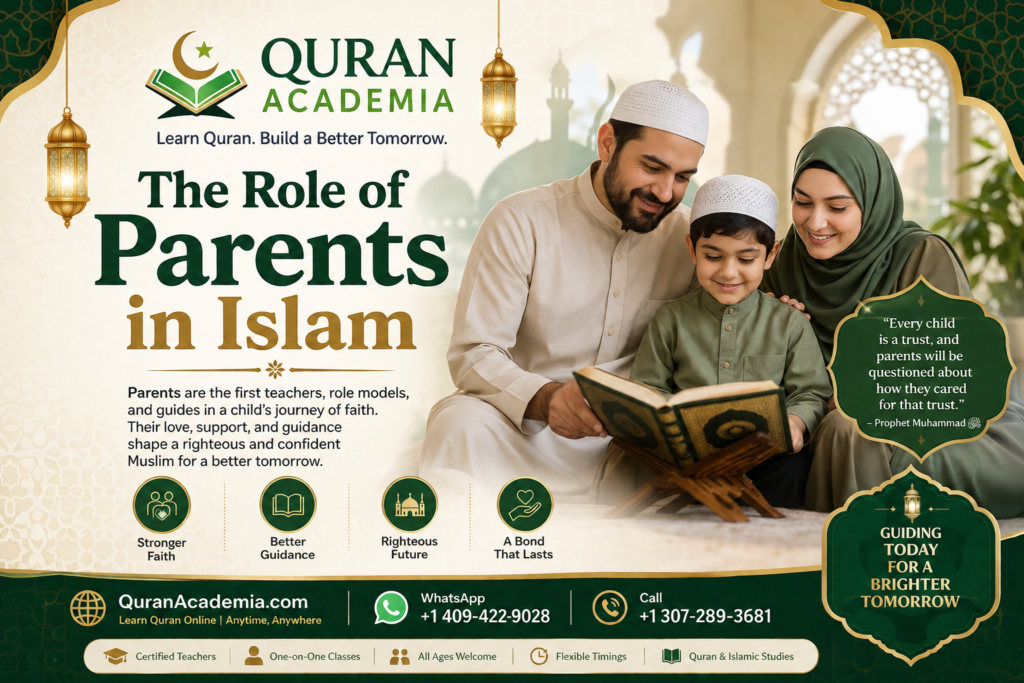
The Role of Parents in Quran Education: Raising a Generation Connected to the Quran
The Role of Parents in Quran Education: Raising a Generation Connected to the Quran
Every parent wants their child to grow into a person of good character, strong faith, and lasting success. In Islam, that goal is inseparable from one thing: a living connection to the Quran. Long before a teacher, a Quran academy, or an online hifz program enters a child’s life, it is the parents who plant the first seed. This is why understanding the role of parents in Quran education is not just a matter of religious duty — it is the foundation of a child’s entire spiritual future.
This blog explores what the Quran and authentic Hadith say about parental responsibility, why early Quran learning matters, and how parents can practically nurture a love for the Quran at home — all while working alongside trusted resources like QuranAcademia.com.
Children Are a Trust (Amanah) From Allah
In Islamic teaching, children are not simply a blessing to enjoy — they are an amanah, a sacred trust given by Allah to their parents. This trust comes with accountability. Parents will be asked on the Day of Judgment how they raised the soul entrusted to them, including whether they gave their children the tools to know their Creator and live by His guidance.
Allah commands believers directly in the Quran:
“O you who have believed, protect yourselves and your families from a Fire whose fuel is people and stones.” (Surah At-Tahrim, 66:6)
Scholars explain that protecting one’s family from this fire is achieved through showing them the right way and teaching them the difference between right and wrong. In practice, this means Quran education is not optional enrichment — it is a core parental obligation, as relevant as feeding or clothing a child.
The Prophetic Model: Parents as the First Guardians of Faith
The Prophet Muhammad ﷺ described the family structure in terms of guardianship and responsibility. As reported in Sahih al-Bukhari, every person is a shepherd responsible for those under their care, and a man is described as the guardian of his family, responsible for them, while a woman is described as the guardian of her husband’s home and children, responsible for them as well.
This Hadith is often cited as the clearest evidence that Islamic parenting is a shared, accountable role — not something to be fully outsourced to a school, a mosque, or an academy. Institutions can support the process, but the responsibility begins and ends at home.
Scholars also draw a direct comparison between prayer and Quran learning. Just as the Prophet ﷺ instructed parents in the Hadith recorded by Abu Dawud to command their children to pray from the age of seven and to be firm about it by the age of ten, many scholars extend the same principle of consistent parental guidance to Quran learning, since the two are deeply connected acts of worship.
The Reward: A Crown of Light on the Day of Judgment
Few incentives are as powerful as the one described in this authentic Hadith. The Prophet ﷺ said that a person who reads the Quran, learns it, and lives by it will cause their parents to be honored on the Day of Resurrection — given a crown of light brighter than the sun, along with garments that surpass anything found in this world (reported by Al-Haakim; graded authentic by Al-Albaani in Saheeh At-Targheeb).
What makes this Hadith remarkable is its scope: this honor applies to parents whether or not they personally taught the child, as long as they supported and enabled that journey. Enrolling a child in structured Quran learning — whether at home, at a local mosque, or through a trusted online Quran academy — falls squarely within that support.
Luqman’s Advice: The Quran’s Own Parenting Curriculum
The Quran does not only tell parents that they are responsible — it shows them how to teach. Surah Luqman records the advice of a wise father to his son, offering what many scholars consider a complete parenting curriculum. His guidance moves through several key stages:
- Establishing correct belief — warning against associating partners with Allah, since this is the greatest injustice.
- Instilling awareness of accountability — teaching that every action, however small, is recorded and will be brought to account.
- Anchoring worship — encouraging consistent prayer as a daily practice.
- Building character — enjoining what is right, forbidding what is wrong, and practicing patience.
- Shaping conduct — teaching humility, moderate speech, and good manners toward others.
This model, drawn directly from the words of Luqman to his son as related in the Quran, shows that Quran-centered parenting is holistic. It is not only about memorizing verses; it is about raising a complete human being whose values, worship, and behavior all flow from the same source.
Why Early Quran Learning Matters So Much
Child development research and Islamic tradition agree on one point: early learning leaves the deepest imprint. A child’s formative years are when language, memory, and moral identity are most malleable. Introducing the Quran early means:
- Language and memorization ability develop naturally, making hifz (memorization) significantly easier than starting in adulthood.
- Values are internalized, not imposed later — a child who grows up hearing and reciting the Quran experiences it as normal, not foreign.
- Emotional attachment to faith is built through positive association, especially when learning is gentle and encouraging rather than forceful.
On that last point, scholars are clear that method matters as much as intention. True parenting in Islam is built on mercy, with faith flourishing when it is taught with patience and affection rather than harshness. Pressuring a child into the Quran without warmth can create resistance; guiding them with consistency, encouragement, and personal example builds lasting love for it instead.
Practical Ways Parents Can Support Quran Education at Home
Understanding the religious weight of this responsibility is the first step. Living it out day to day is the real work. Here are practical steps parents can take:
1. Be the Example
Children imitate what they see far more than what they are told. A parent who recites Quran regularly, even a few verses a day, silently teaches their child that the Quran belongs in daily life, not just in class.
2. Create a Quran-Friendly Environment
Simple habits — playing Quran recitation at home, keeping a Mushaf accessible, celebrating small memorization milestones — build familiarity and comfort with the Quran long before formal lessons begin.
3. Choose the Right Learning Support
Not every parent has the time, language fluency, or tajweed expertise to teach Quran directly. This is where enrolling children with qualified, structured programs — such as those offered by QuranAcademia.com — becomes a means of fulfilling the parental duty, not replacing it. Working with certified teachers ensures correct tajweed, proper memorization technique, and a structured curriculum suited to the child’s age.
4. Stay Involved, Even With a Teacher
Parental involvement should not stop once a tutor is hired. Reviewing lessons together, asking about what was learned, and praying for a child’s progress keeps the parent central to the process, exactly as the Hadith of guardianship describes.
5. Make Dua Consistently
Beyond method and structure, parents are encouraged to make sincere dua for their children’s guidance. Many scholars note that consistent supplication, paired with practical effort, is part of the balanced approach the Quran itself models through Luqman’s example.
6. Prioritize Mercy Over Pressure
Discipline and consistency matter, but so does emotional safety. A child who associates the Quran with warmth and encouragement is far more likely to carry that love into adulthood than one who associates it only with pressure.
Conclusion: Parents Are the First Teachers of the Quran
The role of parents in Quran education cannot be delegated entirely, no matter how excellent the teacher or the academy. Parents are the first example, the first environment, and the first source of encouragement a child experiences. The Quran and Sunnah are unambiguous: this is a trust, an accountability, and — when fulfilled with sincerity — a means of extraordinary reward that connects a parent’s own record of good deeds to their child’s relationship with the Quran, for life and beyond.
At QuranAcademia.com, we see our role as a partnership with parents — not a replacement for them. Whether your child is just beginning to recognize Arabic letters or is progressing through hifz, structured, qualified guidance can help you fulfill this trust with confidence and consistency.
References
- Islamweb — Reward of Parents Whose Child Learned Quran: https://www.islamweb.net/en/fatwa/365263/reward-of-parents-whose-child-learned-quran
- Islamweb — Responsibilities of Parents: https://www.islamweb.net/en/article/150794/responsibilities-of-parents
- QuranReading.com — Rights of Children in Islam According to Quran and Sunnah: https://www.quranreading.com/blog/rights-of-children-in-islam-according-to-quran-and-sunnah
- Tarbiya Learning Academy — Prophetic Parenting: Lessons from the Quran & Sunnah: https://www.tarbiyalearningacademy.com/post/prophetic-parenting-lessons-from-the-quran-sunnah
- Buruj Academy — Is It Haram to Force Your Child to Read the Quran?: https://burujacademy.com/blog/force-your-child-to-read-the-quran/
- Najam Academy — Is It Haram to Force Your Child to Read the Quran?: https://najamacademy.com/is-it-haram-to-force-your-child-to-read-the-quran/
Note: Hadith gradings and translations should always be verified against primary collections (Sahih al-Bukhari, Sahih Muslim, Sunan Abu Dawud) or a qualified scholar before publishing for a religious audience.