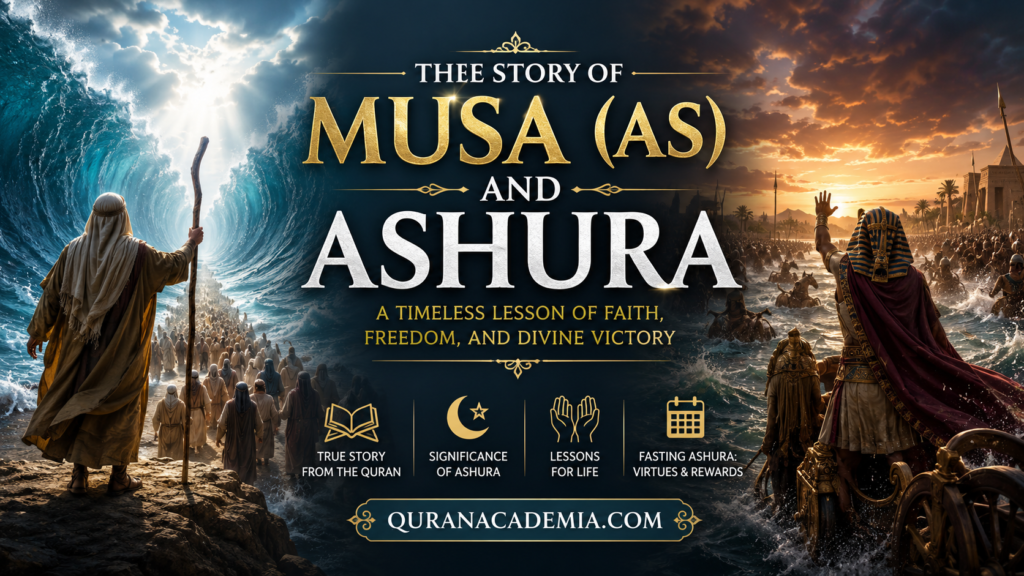
The Story of Prophet Musa (AS) and Ashura: A Timeless Lesson of Faith, Freedom, and Divine Victory
The Day of Ashura is one of the most significant days in the Islamic calendar. Observed on the 10th day of Muharram, Ashura holds immense spiritual value for Muslims around the world. While many believers know that fasting on this day is highly recommended, fewer fully understand the profound historical event behind it—the miraculous rescue of Prophet Musa (AS) and the Children of Israel from Pharaoh’s oppression.
The story of Musa (AS) and Ashura is more than a historical account. It is a timeless lesson about faith in Allah, patience during trials, courage against tyranny, and the certainty of divine help. Every year, when Muslims fast on Ashura, they commemorate Allah’s victory granted to His Prophet Musa (AS) and his followers.
In this comprehensive guide, we will explore the story of Prophet Musa (AS), the significance of Ashura in Islam, the lessons Muslims can learn from this remarkable event, and how believers can benefit spiritually from this blessed day.
What Is Ashura?
Ashura comes from the Arabic word “Asharah,” meaning “ten,” referring to the tenth day of Muharram.
Muharram is one of the four sacred months mentioned in the Quran:
“Indeed, the number of months with Allah is twelve months in the register of Allah from the day He created the heavens and the earth; of these, four are sacred.” (Quran 9:36)
The Day of Ashura was already known among previous nations. It became especially significant because it was the day Allah saved Prophet Musa (AS) and the Children of Israel from Pharaoh.
When Prophet Muhammad ﷺ migrated to Madinah, he found the Jews fasting on this day.
Ibn Abbas (RA) reported:
“The Prophet ﷺ came to Madinah and saw the Jews fasting on the day of Ashura. He asked, ‘What is this?’ They said, ‘This is a righteous day. It is the day when Allah saved Musa and the Children of Israel from their enemy, so Musa fasted on this day.’ The Prophet ﷺ said, ‘We have more right to Musa than you.’ Then he fasted and commanded the Muslims to fast.”
(Sahih al-Bukhari)
This hadith establishes the direct connection between Ashura and the story of Musa (AS).
Who Was Prophet Musa (AS)?
Prophet Musa (AS), known as Moses in English, is one of the greatest prophets in Islamic history.
His story is mentioned more frequently in the Quran than that of any other prophet. Allah mentions Musa (AS) over 130 times throughout different chapters of the Quran.
Musa (AS) was sent to:
- Call people to worship Allah alone
- Guide the Children of Israel
- Challenge the tyranny of Pharaoh
- Establish justice and righteousness
His life demonstrates perseverance, trust in Allah, leadership, and steadfastness in faith.
The Oppression of Pharaoh
To understand Ashura, we must first understand the circumstances faced by Musa (AS) and his people.
Pharaoh ruled Egypt with absolute power and arrogance. He claimed divinity and demanded worship from his subjects.
Allah says:
“Indeed, Pharaoh exalted himself in the land and made its people into factions, oppressing a sector among them…” (Quran 28:4)
The Children of Israel suffered severe persecution under Pharaoh’s rule.
Their hardships included:
- Forced labor
- Slavery
- Torture
- Humiliation
- Killing of newborn sons
Pharaoh feared a prophecy that a boy from the Children of Israel would grow up to challenge his kingdom.
As a result, he ordered the execution of male infants.
This oppressive environment set the stage for one of the greatest miracles in history.
The Birth of Musa (AS)
Musa (AS) was born during this period of intense oppression.
Allah inspired his mother with a remarkable instruction:
“And We inspired the mother of Musa, saying, ‘Suckle him; but when you fear for him, cast him into the river and do not fear and do not grieve. Indeed, We will return him to you and make him among the messengers.'” (Quran 28:7)
Trusting Allah completely, she placed her baby in a basket and set him afloat on the Nile River.
The basket eventually reached Pharaoh’s household.
Ironically, the child Pharaoh feared most was raised in his own palace.
Allah says:
“And the family of Pharaoh picked him up so that he would become to them an enemy and a cause of grief.” (Quran 28:8)
This event demonstrates one of the greatest lessons of tawakkul (trust in Allah): when Allah decrees protection, no force can prevent it.
Musa (AS) Grows Up in Pharaoh’s Palace
Musa (AS) grew up with privilege and education inside Pharaoh’s palace.
Despite living among Egypt’s elite, Allah preserved his faith and identity.
As Musa (AS) matured, he became aware of the suffering faced by his people.
One day, he witnessed an Egyptian fighting with an Israelite.
Attempting to stop the conflict, Musa (AS) accidentally struck the Egyptian, causing his death.
Immediately realizing his mistake, Musa (AS) turned to Allah in repentance:
“My Lord, indeed I have wronged myself, so forgive me.” (Quran 28:16)
Allah forgave him, demonstrating the importance of sincere repentance.
Musa (AS) Leaves Egypt
After this incident, Pharaoh’s officials plotted against Musa (AS).
A believer warned him:
“Indeed, the eminent ones are conferring over you to kill you, so leave.” (Quran 28:20)
Musa (AS) fled Egypt and traveled to Madyan.
Alone and uncertain about his future, he made a heartfelt dua:
“My Lord, indeed I am, for whatever good You would send down to me, in need.” (Quran 28:24)
This beautiful supplication remains one of the most beloved duas for sustenance and guidance.
In Madyan, Musa (AS) found shelter, married, and spent years preparing for his prophetic mission.
The Call to Prophethood
While returning from Madyan, Musa (AS) noticed a fire near Mount Tur.
Approaching it, he heard Allah’s voice:
“Indeed, I am Allah. There is no deity except Me, so worship Me and establish prayer for My remembrance.” (Quran 20:14)
At this moment, Musa (AS) received prophethood.
Allah granted him miraculous signs:
- The staff turning into a serpent
- His hand shining brightly
- Divine support and revelation
He was instructed to confront Pharaoh and call him toward the worship of Allah.
Musa (AS) Confronts Pharaoh
Despite Pharaoh’s immense power, Musa (AS) obeyed Allah’s command.
He approached Pharaoh and said:
“Indeed, we are messengers of the Lord of the worlds.” (Quran 26:16)
Pharaoh rejected the message and mocked Musa (AS).
He accused him of sorcery and arrogance.
Yet Musa (AS) remained firm.
One of the greatest lessons here is that truth does not depend on popularity or power. Believers must stand for justice even when facing overwhelming opposition.
The Contest of the Magicians
Pharaoh organized a public contest between Musa (AS) and the kingdom’s magicians.
The magicians performed impressive illusions, making ropes and staffs appear alive.
Allah says:
“They bewitched the eyes of the people and struck terror into them.” (Quran 7:116)
Then Allah commanded Musa (AS) to throw his staff.
The staff transformed into a real serpent and swallowed the magicians’ tricks.
Recognizing the truth immediately, the magicians prostrated and declared:
“We believe in the Lord of Musa and Harun.” (Quran 20:70)
This moment represents the victory of truth over deception.
Even experts in magic recognized the miracle was from Allah.
Pharaoh’s Increased Oppression
Instead of accepting the truth, Pharaoh became even more tyrannical.
He tortured those who believed.
He threatened the magicians.
He intensified persecution against the Children of Israel.
Yet every act of oppression only brought him closer to destruction.
Allah repeatedly sent signs and warnings:
- Drought
- Floods
- Locusts
- Lice
- Frogs
- Blood
These signs were opportunities for repentance.
However, Pharaoh remained arrogant.
The Quran repeatedly shows that arrogance prevents people from recognizing truth even when evidence is clear.
The Divine Command to Leave Egypt
Eventually, Allah instructed Musa (AS) to lead the Children of Israel out of Egypt.
This was a dangerous mission.
They were escaping one of the most powerful rulers on earth.
Yet Allah promised victory.
Musa (AS) gathered his people and began the journey.
Pharaoh soon discovered their departure.
Enraged, he mobilized his massive army and pursued them.
The stage was set for the event commemorated on Ashura.
The Great Miracle at the Red Sea
As Musa (AS) and his followers approached the sea, they found themselves trapped.
The sea stood before them.
Pharaoh’s army approached from behind.
Panic spread among the Children of Israel.
They cried:
“Indeed, we are to be overtaken!” (Quran 26:61)
At this terrifying moment, Musa (AS) displayed complete trust in Allah.
He replied:
“No! Indeed, with me is my Lord; He will guide me.” (Quran 26:62)
This statement is one of the most powerful expressions of faith in the entire Quran.
When all worldly solutions disappeared, Musa (AS) relied entirely on Allah.
Allah then commanded him:
“Strike the sea with your staff.”
The sea split into enormous pathways.
The Quran says:
“And each portion was like a great towering mountain.” (Quran 26:63)
Musa (AS) and the believers crossed safely.
Meanwhile, Pharaoh and his army followed.
As soon as they entered, Allah caused the waters to return.
Pharaoh and his forces drowned.
The believers were saved.
The oppressors were destroyed.
Truth triumphed over falsehood.
Faith triumphed over tyranny.
This miraculous rescue is the central event remembered on Ashura.
Pharaoh’s Final Moments
As death approached, Pharaoh finally declared belief.
Allah records his words:
“I believe that there is no deity except the One in whom the Children of Israel believe.” (Quran 10:90)
But his repentance came too late.
Allah responded:
“Now? While you had disobeyed before and were among the corrupters?” (Quran 10:91)
His story remains a warning against delaying repentance.
No one knows when death will arrive.
Believers should return to Allah before it is too late.
Why Did Musa (AS) Fast on Ashura?
After Allah granted victory and salvation, Musa (AS) fasted as an expression of gratitude.
Fasting became a way to:
- Thank Allah
- Remember His blessings
- Commemorate divine help
- Strengthen faith
When Prophet Muhammad ﷺ learned of this practice, he affirmed it and encouraged Muslims to fast.
The Messenger of Allah ﷺ said:
“Fasting the day of Ashura, I hope Allah will expiate the sins of the previous year.”
(Sahih Muslim)
Thus, Ashura became an important voluntary fast in Islam.