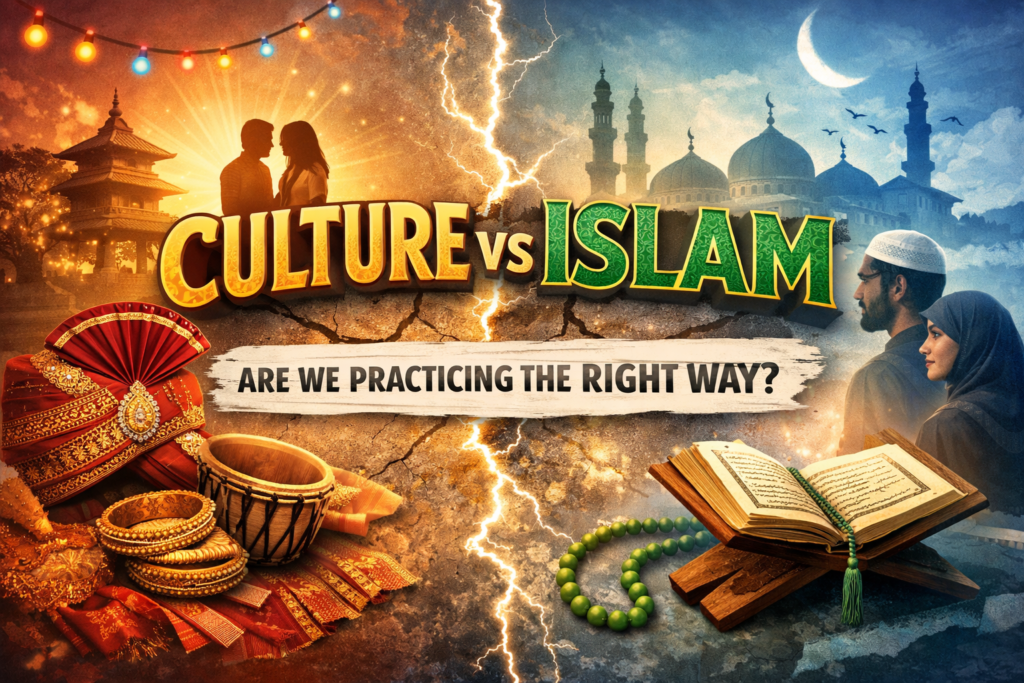
Culture vs Islam: Are We Practicing the Right Way?
In today’s rapidly evolving world, many Muslims struggle to distinguish between Islamic teachings and cultural traditions. Practices passed down through generations are often assumed to be part of Islam—yet not all of them align with the teachings of the Qur’an and Sunnah.
This raises a critical question:
👉 Are we truly following Islam, or are we unknowingly practicing culture in the name of religion?
Understanding this difference is essential for every Muslim who seeks to live a life pleasing to Allah.
📖 What is Islam vs What is Culture?
🕋 Islam: Divine Guidance
Islam is a complete way of life revealed by Allah through:
- The Qur’an
- The teachings of Prophet Muhammad (peace be upon him)
It is:
- Universal
- Timeless
- Free from human bias
Allah says:
“This day I have perfected for you your religion…” (Qur’an 5:3)
This confirms that Islam is already complete—no cultural additions are needed.
🌍 Culture: Human Traditions
Culture refers to:
- Customs
- Social norms
- Traditions of a specific region or community
Culture is:
- Man-made
- Changeable
- Influenced by geography and history
👉 Islam allows culture only if it does not contradict Islamic teachings.
⚠️ When Culture Overrides Islam
Many practices today are rooted more in culture than Islam. Let’s explore common examples:
❌ 1. Forced Marriages
In some cultures, individuals are pressured into marriage without consent.
📌 Islamic Teaching:
The Prophet Muhammad said:
“A previously married woman should not be married until consulted, and a virgin until her permission is sought.” (Sahih Bukhari)
👉 Consent is mandatory in Islam, making forced marriages un-Islamic.
❌ 2. Extravagant Weddings
Lavish weddings with unnecessary expenses are often cultural expectations.
📌 Islamic Teaching:
- Islam encourages simplicity
- Wastefulness is discouraged
“Indeed, the wasteful are brothers of the devils…” (Qur’an 17:27)
❌ 3. Gender Inequality
Cultural norms sometimes deny women their Islamic rights.
📌 Islamic Teaching:
Islam granted women rights over 1400 years ago:
- Right to education
- Right to inheritance
- Right to consent
👉 These rights are often suppressed by culture—not Islam.
❌ 4. Bid‘ah (Innovations in Religion)
Adding new practices into religion without evidence from Qur’an or Sunnah.
📌 Islamic Teaching:
The Prophet Muhammad said:
“Whoever introduces something into this matter of ours that is not from it, it will be rejected.” (Sahih Muslim)
✅ When Culture Aligns with Islam
Not all culture is bad. Islam embraces cultural practices that:
- Promote modesty
- Encourage family values
- Do not contradict Shariah
👉 Example:
- Traditional clothing that maintains hijab
- Cultural hospitality and respect for elders
📌 Principle:
Culture is acceptable as long as it stays within Islamic boundaries.
🧠 Why Do Muslims Confuse Culture with Islam?
1. Lack of Knowledge
Many Muslims follow traditions without verifying them through authentic sources.
2. Blind Following (Taqlid)
Following ancestors without questioning:
“Indeed, we found our forefathers upon a religion…” (Qur’an 43:22)
3. Social Pressure
Fear of المجتمع (society) often outweighs fear of Allah.
4. Emotional Attachment to Traditions
People feel culturally connected and hesitate to change—even if it contradicts Islam.
🔍 How to Differentiate Between Culture and Islam
✔️ 1. Verify with Qur’an and Sunnah
Ask:
👉 Is this practice supported by authentic Islamic sources?
✔️ 2. Seek Knowledge
Learn Islam from:
- Qualified scholars
- Authentic books of Hadith
✔️ 3. Ask Scholars
When in doubt, consult knowledgeable people.
✔️ 4. Reflect on Intentions
Are you doing something:
- To please Allah?
- Or to satisfy society?
🌱 Returning to Pure Islam
To practice Islam correctly:
- Follow the Qur’an and Sunnah strictly
- Avoid innovations
- Educate your family
- Be willing to challenge harmful traditions
Allah says:
“And hold firmly to the rope of Allah all together and do not become divided…” (Qur’an 3:103)
💡 Practical Tips for Daily Life
- 📌 Question cultural practices respectfully
- 📌 Promote simple and Sunnah-based weddings
- 📌 Teach children authentic Islam
- 📌 Avoid peer pressure in religious matters
- 📌 Follow evidence, not emotions
Conclusion
The line between culture and Islam can sometimes blur—but as Muslims, our ultimate معيار ( معيار = standard ) is clear:
👉 The Qur’an and the Sunnah.
Cultural practices may shape our identity, but they must never override divine guidance.
Let us strive to:
- Purify our beliefs
- Align our actions with Islam
- Practice the deen as it was revealed
✨ Because true success lies not in following الناس (people), but in following the path of Allah.