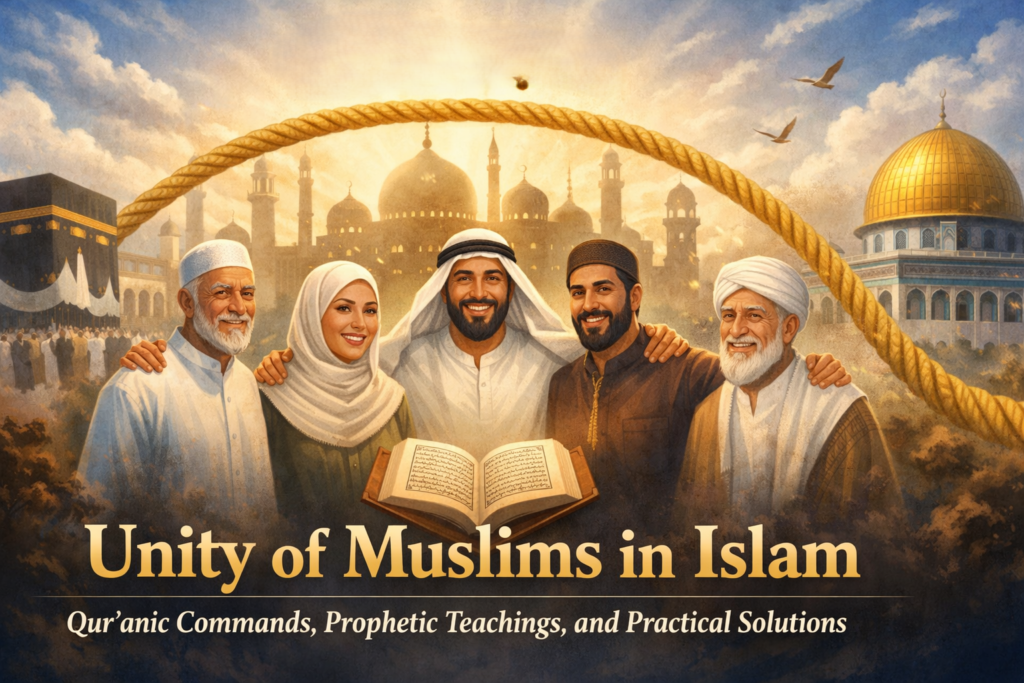
Unity of Muslims in Islam: Qur’anic Commands, Prophetic Teachings, and Practical Solutions
Introduction: Why Muslim Unity Matters Today
The unity of Muslims (Ummah) is not a symbolic concept or a mere emotional slogan; it is a foundational principle of Islam deeply rooted in the Qur’an and the Sunnah. From the earliest days of Islam, unity was the strength that transformed a small, persecuted community into a civilization that shaped history, ethics, knowledge, and justice.
In today’s world—marked by sectarianism, nationalism, political division, and cultural fragmentation—the need for Muslim unity is more urgent than ever. Disunity weakens the Ummah spiritually, socially, economically, and politically, while unity strengthens faith, resilience, and collective purpose.
This comprehensive, semantical article explores the unity of Muslims through:
-
Qur’anic guidance
-
Authentic Hadith references
-
Historical examples
-
Causes of disunity
-
Practical steps to revive unity in the modern age
The Concept of Ummah in Islam
Meaning of Ummah
The word Ummah refers to a unified community bound together by faith, values, and divine purpose. Islam redefined identity—not by race, language, or geography—but by belief in Allah and obedience to His guidance.
Allah says:
“Indeed, this Ummah of yours is one Ummah, and I am your Lord, so worship Me.”
(Qur’an 21:92)
This verse establishes unity as a divine command, not a human preference.
Unity as a Command from Allah

One of the most powerful verses on unity states:
“And hold firmly to the rope of Allah all together and do not become divided.”
(Qur’an 3:103)
Key Lessons from This Verse
-
Unity is collective – “all together”
-
Division is prohibited – “do not become divided”
-
The rope of Allah symbolizes the Qur’an and Sunnah
Disunity, therefore, is not just a social failure—it is a spiritual violation.
The Prophet ﷺ and the Brotherhood of Believers
The teachings and actions of Prophet Muhammad consistently emphasized unity, brotherhood, and compassion.
He said:
“The believers, in their mutual love, mercy, and compassion, are like one body; when one limb suffers, the whole body responds with wakefulness and fever.”
(Sahih al-Bukhari & Sahih Muslim)
This Hadith defines unity as:
-
Emotional connection
-
Shared responsibility
-
Collective pain and healing
Brotherhood Beyond Race and Tribe
In his Farewell Sermon, the Prophet ﷺ declared:
“No Arab has superiority over a non-Arab, nor a non-Arab over an Arab… except by righteousness.”
This revolutionary message shattered racial, tribal, and national barriers—laying the foundation for a global Muslim identity.
Unity in the Qur’an: Repeated Divine Emphasis
Allah repeatedly warns against division:
“And do not be like those who became divided and differed after clear proofs had come to them.”
(Qur’an 3:105)
“Indeed, the believers are brothers, so make peace between your brothers.”
(Qur’an 49:10)
These verses show that:
-
Brotherhood is a fact, not a suggestion
-
Reconciliation is an obligation
-
Division leads to punishment and loss
Historical Examples of Muslim Unity
1. The Brotherhood of Madinah (Mu’akhah)
When the Prophet ﷺ migrated to Madinah, he established brotherhood between the Muhajirun and Ansar, uniting people of different backgrounds into one Ummah.
This unity:
-
Eliminated class differences
-
Strengthened economic support
-
Created spiritual solidarity
2. Unity During the Khilafah Rashidah
Under the rightly guided Caliphs, Muslims remained united around:
-
Justice
-
Consultation (Shura)
-
Adherence to Qur’an and Sunnah
As a result, Islam spread rapidly—not by force, but by character, justice, and unity.
Causes of Disunity Among Muslims Today

1. Sectarianism and Fanaticism
Differences in jurisprudence or theology become sources of hostility instead of scholarly diversity.
2. Nationalism Over Ummah Identity
Loyalty to borders, flags, and politics often outweighs loyalty to faith.
3. Ignorance of Islamic Teachings
Lack of authentic knowledge leads to misunderstanding, extremism, and division.
4. Ego, Pride, and Power Struggles
The Qur’an warns that arrogance leads to destruction and separation.
The Dangers of Disunity in Islam
Allah clearly links disunity with weakness:
“And do not dispute and [thus] lose courage and then your strength would depart.”
(Qur’an 8:46)
Consequences of Division
-
Loss of Allah’s help
-
Moral and spiritual decline
-
Political and economic weakness
-
Internal conflicts and suffering
History proves that whenever Muslims became divided, they became vulnerable.
Unity Does Not Mean Uniformity
Islam recognizes legitimate differences.
Imam Ash-Shafi‘i said:
“My opinion is correct but could be wrong, and another’s opinion is wrong but could be correct.”
Islam Encourages:
-
Respectful disagreement
-
Mutual tolerance
-
Scholarly dialogue
Unity is about hearts and goals, not identical opinions.
Practical Steps to Restore Unity of the Ummah

1. Return to the Qur’an and Sunnah
The Qur’an is the ultimate unifier of hearts.
2. Promote Islamic Education
Knowledge removes ignorance, extremism, and hatred.
3. Focus on Common Beliefs
All Muslims agree on:
-
Tawheed
-
Prophethood
-
Salah, Zakah, Fasting, Hajj
4. Avoid Backbiting and Takfir
The Prophet ﷺ warned against declaring others disbelievers without clear proof.
5. Strengthen Community Bonds
Masjids, charity, social support, and collective worship nurture unity.
Unity and Social Justice
Unity is inseparable from justice.
Allah says:
“Indeed, Allah loves those who act justly.”
(Qur’an 49:9)
An Ummah united upon injustice will fail, but an Ummah united upon truth and justice earns divine support.
Unity as a Source of Divine Mercy
The Prophet ﷺ said:
“Allah’s Hand is with the الجماعة (community).”
(Tirmidhi)
Unity attracts:
-
Allah’s mercy
-
Protection from misguidance
-
Strength in trials
Disunity invites hardship.
Unity in the Modern Global Context
In an age of:
-
Media manipulation
-
Political agendas
-
Sectarian propaganda
Muslims must rise above division and revive:
-
Intellectual unity
-
Moral unity
-
Spiritual unity
Unity does not erase diversity—it elevates it under faith.
Conclusion: One Ummah, One Purpose
The unity of Muslims is not optional—it is fardh (obligatory). The Qur’an, the Sunnah, and Islamic history all testify that unity leads to honor, strength, and divine help, while division leads to weakness and loss.
Allah reminds us:
“You are the best nation produced for mankind.”
(Qur’an 3:110)
But this honor is conditional—upon unity, righteousness, and obedience to Allah.
May Allah unite the hearts of the Ummah, remove hatred and division, and guide us back to the path of brotherhood, mercy, and truth. Ameen.